Yuzu Money
Institutional-grade risk management. Onchain transparency. Yield Engine for Everyone.
What is Yuzu Money?
Yuzu Money offers risk-curated, onchain strategies packaged as structured yield products suitable for various investor risk profiles. Our investment philosophy prioritizes capital preservation, with comprehensive risk coverage across smart contracts, wallet infrastructure, and investment strategies.
Structured Products
Insititutional-grade tokenized traditional finance assets packaged into the following structured yield products:
- Yuzu Marketplace
- Yuzu Prime
- Yuzu Cash
Yuzu Alpha
Overcollateralized yield-bearing stablecoin product composable with onchain (Decentralized Finance) integrations:
With Yuzu Money, anyone and everyone can access safe, stable, and consistent fixed income through Yuzu Money's structured yield products.
Yuzu Marketplace
Yuzu Marketplace: Curated vault strategies
Yuzu Marketplace is a curated venue for on-chain yield — a hand-picked set of vault strategies, spanning multiple chains and assets, that gives everyday users direct access to yield opportunities.
Key Characteristics
Curated Vault Strategies: Every vault is sourced, diligenced, and structured by the Yuzu team. Instead of asking users to hunt across protocols, chains, and counterparties, Yuzu does the work — surfacing institutional-grade, hard-to-reach strategies (structured private credit, leveraged RWA yield, tokenized T-Bills, and more) as a single, ready-to-deposit yield vault.
Access to Overlooked Opportunities: The strongest yield is usually locked behind size minimums, closed allocations, unfamiliar venues, or chains most users never touch. The Marketplace closes that gap — packaging the strategies typical users miss into vaults anyone can enter, with the diligence already done and published through our research arm.
Permissionless Access: Marketplace vaults are open and self-custodial. No gating, no eligibility screening to deposit or withdraw — users interact directly with the vault smart contract from their own wallet.
Priority Access for Yuzu Alpha & Prime Users: Existing holders of yzUSD and yzPrime receive priority access and whitelisting to new and capacity-constrained vaults — including early subscription windows ahead of the wider market.
Multi-Chain, Multi-Asset, Curated: Vaults span multiple chains (e.g. Ethereum, Monad, Pharos, Plasma) and accept a range of deposit assets (e.g. USDC, USDe), each mapped to a clearly labelled strategy, underlying venue, and risk tier.
On-Chain Transparency: Each vault page surfaces its strategy, composition, venues, fees, leverage, TVL, and live APY — so the source of every yield is visible and verifiable before depositing.
Subscription & Redemption: Liquidity terms are set per vault. Many are continuously redeemable; structured-credit vaults run on fixed subscription/redemption cycles, shown on each vault's page.
Key Addresses
Core Yuzu Marketplace Contracts
| Vault | Blockchain | Address |
|---|---|---|
| yzSyrup | EthereumchainID 1 | 0xC9854f2AF89d4d26837004d1e154Bd3C3C1009b1 |
| yzCash | EthereumchainID 1 | 0x224e90591A2d63fb66E677D0561Ea4A6Ad1F098D |
| yzmGLOBAL | EthereumchainID 1 | 0x7c5ed3b2DC8c353D685005B9e06e3250d47d839E |
Yuzu Prime
Yuzu Prime: Enhanced institutional-grade fixed-income yield
Key Characteristics
Yuzu Prime (yzPrime) offers returns superior to SOFR / T-bill returns through its leveraged strategies on underlying basket composition comprised of various institutional-grade tokenized traditional finance products:
- U.S. Treasury Bills (T-bills)
- A-grade Investment Credit (AAA Collateralized Loan Obligations - CLOs)
- Overcollateralized Lending (e.g. Maple Finance)
Yield Distribution: Yield distributed to yzPrime is continuous (with no weekly epochs unlike Yuzu Alpha).
On-Chain Proof: Collateral is always on-chain; a Proof of Reserves dashboard allows users to verify Yuzu Prime product's assets (backing assets / collateral) and liabilities (net supply of yzPrime minted).
Underlying Strategies: Subject to Asset Whitelist mandate and transparently verifiable via Yuzu (Accountable) dashboard.
Mint/Redeem (Gated): Subject to eligibility and KYC/AML/KYB/SoF/SoW screening, only Eligible Investors (defined below) may mint or redeem yzPrime for USDC at yzPrime's prevailing NAV, honoring program rules and risk limits.
Access & Eligibility (Accredited/Qualified Only)
Primary minting and redeeming of yzPrime are restricted to Accredited, Qualified, Institutional, or Sophisticated Investors ("Eligible Investors") based on their country of residence or incorporation. Access is subject to completion of KYC/KYB, sanctions screening, AML/CFT checks, and Source-of-Funds/Source-of-Wealth verification. Each participant must also provide reasonable proof of Eligible Investor status and execute a declaration confirming they are and wish to be treated as such under the laws and regulations of their jurisdiction. Yuzu Money may decline, pause, or revoke access, or require updated evidence, at any time to remain compliant. Retail users are not eligible to mint, subscribe, or redeem yzPrime.
Mint & Redeem
Minters mint/redeem yzPrime with USDC, subject to each related rule and prerequisite. Inflows are placed into the Collateral Pool and then deployed into curated strategies (institutional-grade tokenized RWAs) per policy. Flow diagrams (mint/redeem and protocol fund flows) are shown below.
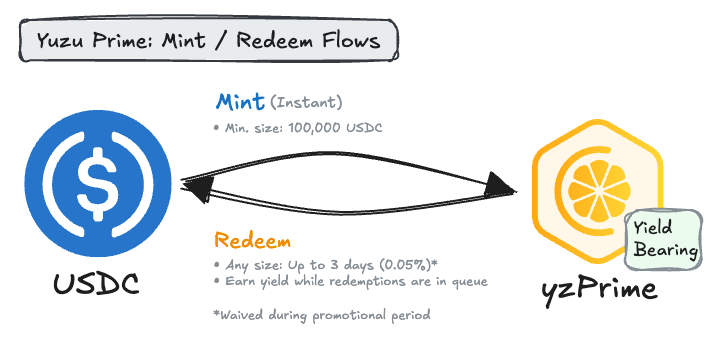
Product Fund Flows
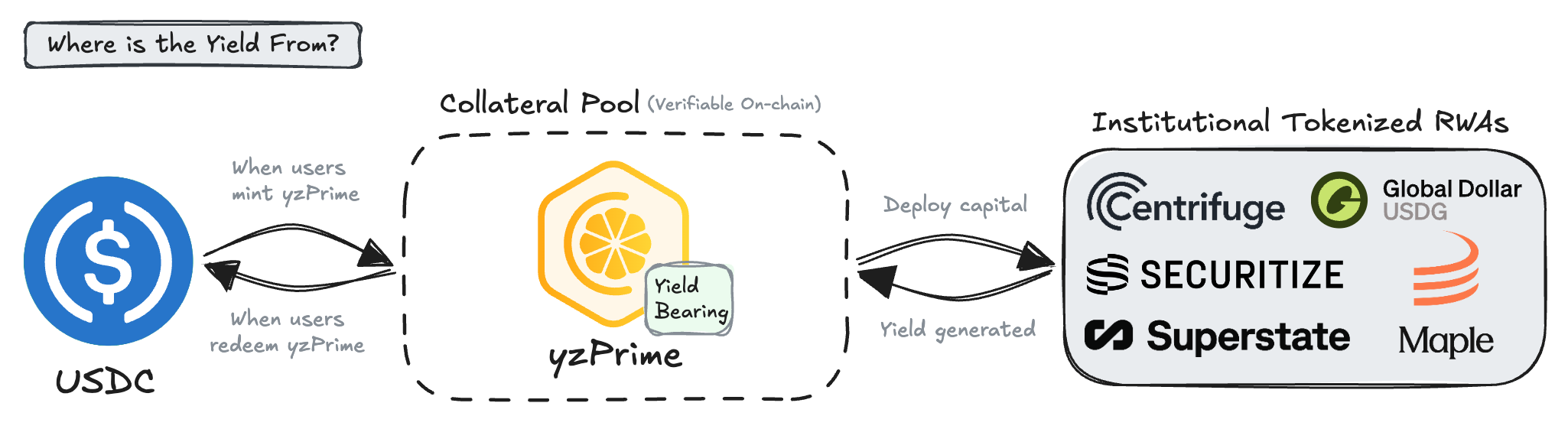
The flow of funds for Yuzu Prime is as illustrated below.
When the user mints or redeems yzPrime, USDC is deposited into the Collateral Pool. USDC in the Collateral Pool is then deployed into curated leverage strategies.
Key Addresses
Core Yuzu Prime Contracts
| Blockchain | yzPrime |
|---|---|
MonadchainID 143 | 0xc9ea90692757831d98Ac629F2A0140E02b80A7DA |
Wallets for NAV
- Main Fund 1
- Main Fund 2
- Main Fund 3
- Main Fund 4
- Main Fund 5
- External OTC Mint/Redeem 1
- yzPrime Mint Wallet
Refer to our Independent Proof of Solvency by Accountable for the latest info.
Yuzu Stablecoin (yzUSD)
Yuzu Alpha: Senior tranche product
yzUSD is intended to be an overcollateralized, stable value, asset referenced token targeting US$1.
Key Characteristics
Synthetic Dollar Intent: yzUSD targets stability at $1; in base form, it does not itself bear yield.
Staking Pathway: Holders may stake yzUSD to receive syzUSD, a liquid, yield accruing ERC-4626 vault token that enables further DeFi composability.
OnChain Proof: Collateral is always onchain; a Proof of Reserves dashboard allows users to verify that every yzUSD is backed by > US$1 in eligible on chain assets.
Mint/Redeem (Gated): Subject to eligibility and KYC/AML/KYB/SoF/SoW screening, only Eligible Investors (defined below) may mint or redeem yzUSD for USDT0 at 1:1, honoring program rules and risk limits.
Access & Eligibility (Accredited/Qualified Only)
Primary minting and redeeming of yzUSD are restricted to Accredited, Qualified, Institutional, or Sophisticated Investors ("Eligible Investors") based on their country of residence or incorporation. Access is subject to completion of KYC/KYB, sanctions screening, AML/CFT checks, and Source-of-Funds/Source-of-Wealth verification. Each participant must also provide reasonable proof of Eligible Investor status and execute a declaration confirming they are and wish to be treated as such under the laws and regulations of their jurisdiction. Yuzu Money may decline, pause, or revoke access, or require updated evidence, at any time to remain compliant. Retail users are not eligible to mint, subscribe, or redeem yzUSD.
Secondary Market Trading (Open)
Once validly minted into circulation, yzUSD is intended to function as a pure stablecoin that may be traded by anyone in relevant secondary markets — including CEXs and DEXs — that choose to list or support it, subject to those venues' own rules and applicable law. Yuzu Money does not operate these venues.
Collateral Pool (Backing Assets)
The Collateral Pool consists of curated onchain strategies and assets. Through Accountable, it is verified in near real-time that yzUSD is backed by >$1 of assets.
- When the Backing's NAV exceeds the amount required to maintain full backing, the surplus (excess NAV) is transferred to the Reserve Fund.
- Conversely, any NAV shortfall is covered from the Reserve Fund.
- "Excess" or "shortfall" refer to deviations from the value needed to keep each yzUSD fully backed at US$1.
Staked yzUSD (syzUSD)
Yuzu Alpha: Yield-bearing (wrapped) version of yzUSD
syzUSD is a technical wrapper, an ERC-4626 vault token that represents staked yzUSD for composability in DeFi. Staking converts form only (yzUSD → syzUSD) and is designed to facilitate integrations and secondary-market use. Any yield accrual to syzUSD reflects the program's policy for yzUSD staking and underlying portfolio performance; the wrapper itself confers no separate rights beyond representing the staked position.
Yield Distribution: Yield distributed to syzUSD is decided weekly on Friday and corresponds to the week's epoch (Fri 04:00 UTC → Fri 03:59 UTC).
Unstaking Window: Unstaking syzUSD back to yzUSD is a one-step process, simply unstake and the process completes almost instantly.
Weekly Target Yield
Every Friday (the start of a new weekly epoch), the protocol announces a weekly target yield and the corresponding dollar yield to be distributed for that week, calculated based on TVL at the start of the epoch. This mechanism is designed to enhance user experience by providing a more stable and predictable yield profile over time. You can view the latest and historical target yields on our Transparency dashboard.
The realized APY for users may differ from the target depending on TVL movements during the epoch:
- If TVL decreases during the week, the realized APY will be higher than the weekly target yield, as the same dollar yield is distributed over a smaller TVL.
- If TVL increases during the week, the realized APY will be lower than the weekly target yield, as the same dollar yield is distributed over a larger TVL.
Yuzu Protection Pool (yzPP)
Yuzu Alpha: Junior tranche product
yzPP is Yuzu Money's Yuzu Alpha's first-loss tranche. Depositors accept priority exposure to any losses on the underlying strategies in exchange for higher target yield, funded partly by the Reserve Fund (Reward Mechanism). yzPP sits inside the backing asset pool alongside yzUSD, strengthening the overall collateralization ratio.
Formulas:
Minting:
Deposit USDT0 to mint yzPP (Plasma).
Yield Composition:
yzPP yield has two components: a base yield tracking syzUSD, and an additional protocol-funded yield budget set daily at 04:00 UTC (covering daily 04:00 UTC to 03:59 UTC). The additional budget is sized by the risk premiums policy.
Redemption Conditions:
yzPP is redeemable at any time, subject to a 30-day redemption period during which yield continues to accrue. Throughout this window, depositors remain exposed to first-loss in the event of any loss incurred by Yuzu Money. Redemption orders must meet a minimum size of 5,000 yzPP.
Pending orders can be cancelled (24 hours after the redemption request) and resubmitted at any time. However, only the most recently submitted redemption order will be fulfilled. (e.g. an order placed on Day 7 supersedes one placed on Day 1.)
Access & Eligibility (Accredited/Qualified Only)
Primary minting and redeeming of yzPP are restricted to Accredited, Qualified, Institutional, or Sophisticated Investors ("Eligible Investors") based on their country of residence or incorporation. Access is subject to completion of KYC/KYB, sanctions screening, AML/CFT checks, and Source-of-Funds/Source-of-Wealth verification. Each participant must also provide reasonable proof of Eligible Investor status and execute a declaration confirming they are and wish to be treated as such under the laws and regulations of their jurisdiction. Yuzu Money may decline, pause, or revoke access, or require updated evidence, at any time to remain compliant. Retail users are not eligible to mint, subscribe, or redeem yzPP.
Secondary Market Trading (Open)
Once validly minted into circulation, yzPP is intended to function as yield-bearing stablecoin (Junior Tranche subject to first-loss risk) that may be traded by anyone in relevant secondary markets — including CEXs and DEXs — that choose to list or support it, subject to those venues' own rules and applicable law. Yuzu Money does not operate these venues.
yzPP First-Loss Mechanism
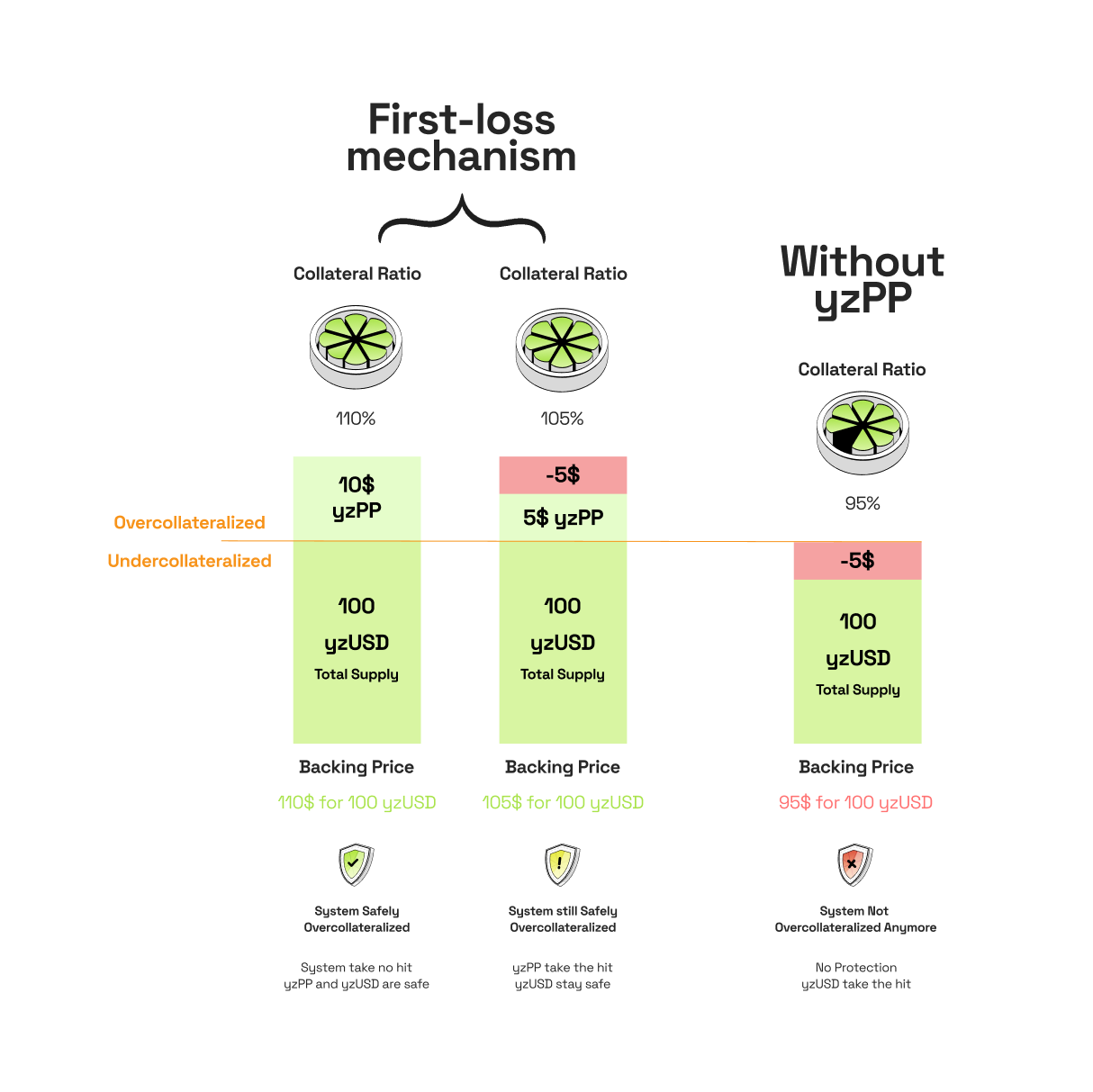
yzPP provides a layer of protection to the yzUSD Collateral Pool via the first-loss mechanism.
Core Concept
- Collateral Pool: $yzUSD is backed by a pool of assets.
- Collateral Ratio: Measures total collateral value relative to $yzUSD supply.
- Example: A pool worth $110 backing 100 $yzUSD gives a 110% ratio.
- Ratios above 100% provide a buffer that helps support the 1:1 peg to USD.
Risk Without Protection
Consider a $5 loss in the Collateral Pool:
- Pool drops to $95.
- Ratio falls to 95%, undercollateralized.
- Each $yzUSD is now only backed by $0.95.
- This could impact redemptions and the peg.
In this scenario, losses flow directly to $yzUSD holders.
How yzPP Absorbs Losses
The yzPP acts as a first-loss buffer:
- A separate pool where participants deposit assets.
- yzPP depositors earn higher rewards in exchange for taking on first-loss risk.
Using the same $5 loss example:
- The $5 impact is absorbed by yzPP (e.g., yzPP falls from $10 to $5).
- The Collateral Pool remains at $105.
- The ratio stays above 100% (105%), ensuring $yzUSD is still fully backed.
- $yzUSD redemptions continue at 1:1 with USD.
| Moment | Collateral Pool | yzPP ($ total) | yzUSD supply | Collateral Ratio | What happens |
|---|---|---|---|---|---|
| Start | $110 | $10 | 100 | 110% | System over-collateralised at 110 % |
| After $5 loss + first-loss | $105 | $5 | 100 | 105% | yzPP is devalued from $10 to $5 to plug the $5 loss |
| Without yzPP first-loss mechanism | $95 | - | 100 | 95% | yzUSD no longer fully backed, all yzUSD holders take the loss |
Mint & Redeem
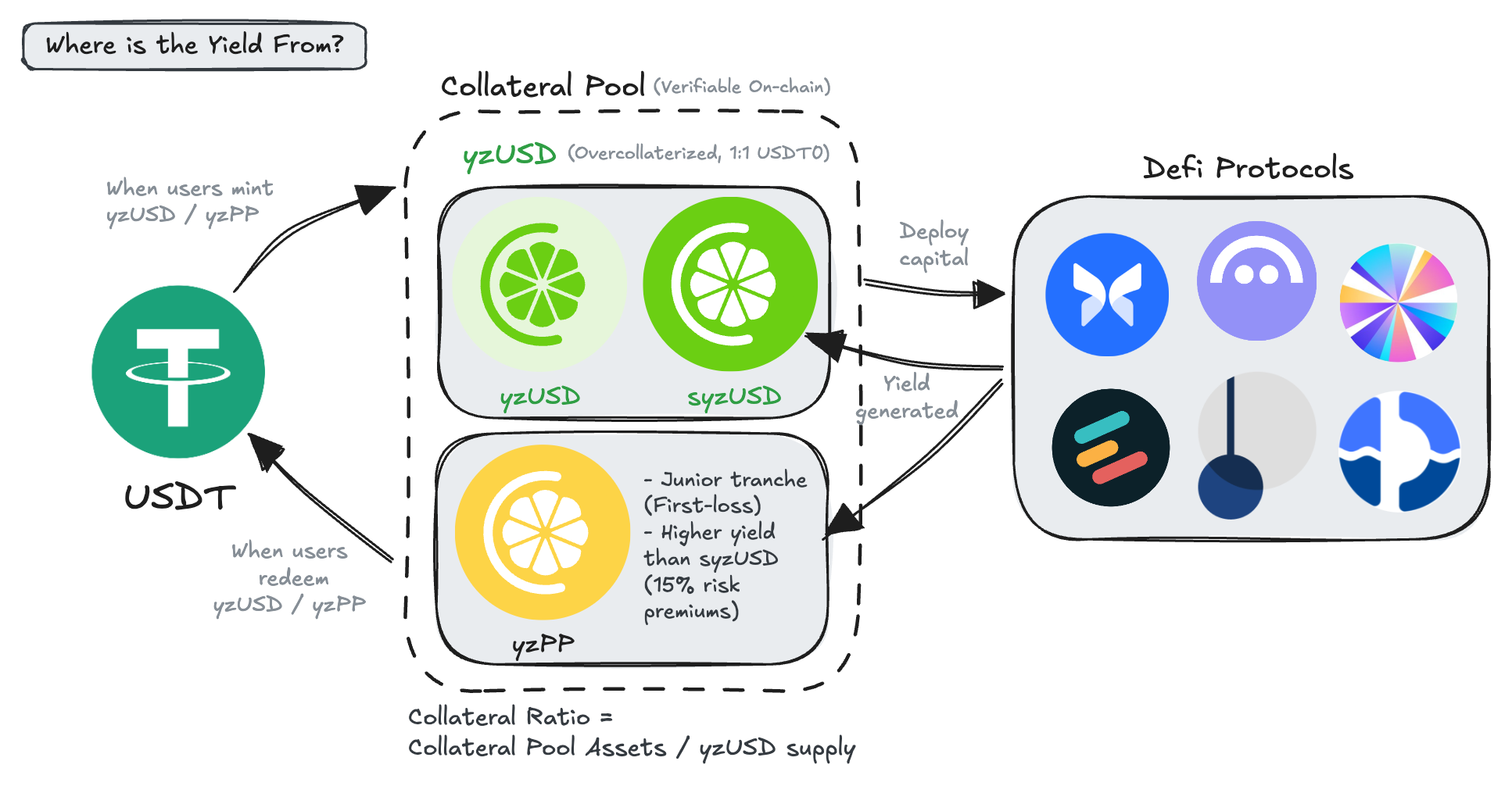
Minters mint/redeem yzUSD and yzPP with USDT0, subject to each related rule and prerequisite. Inflows are placed into the Collateral Pool and then deployed into curated DeFi strategies per policy. Flow diagrams (mint/redeem and protocol fund flows) are shown below.
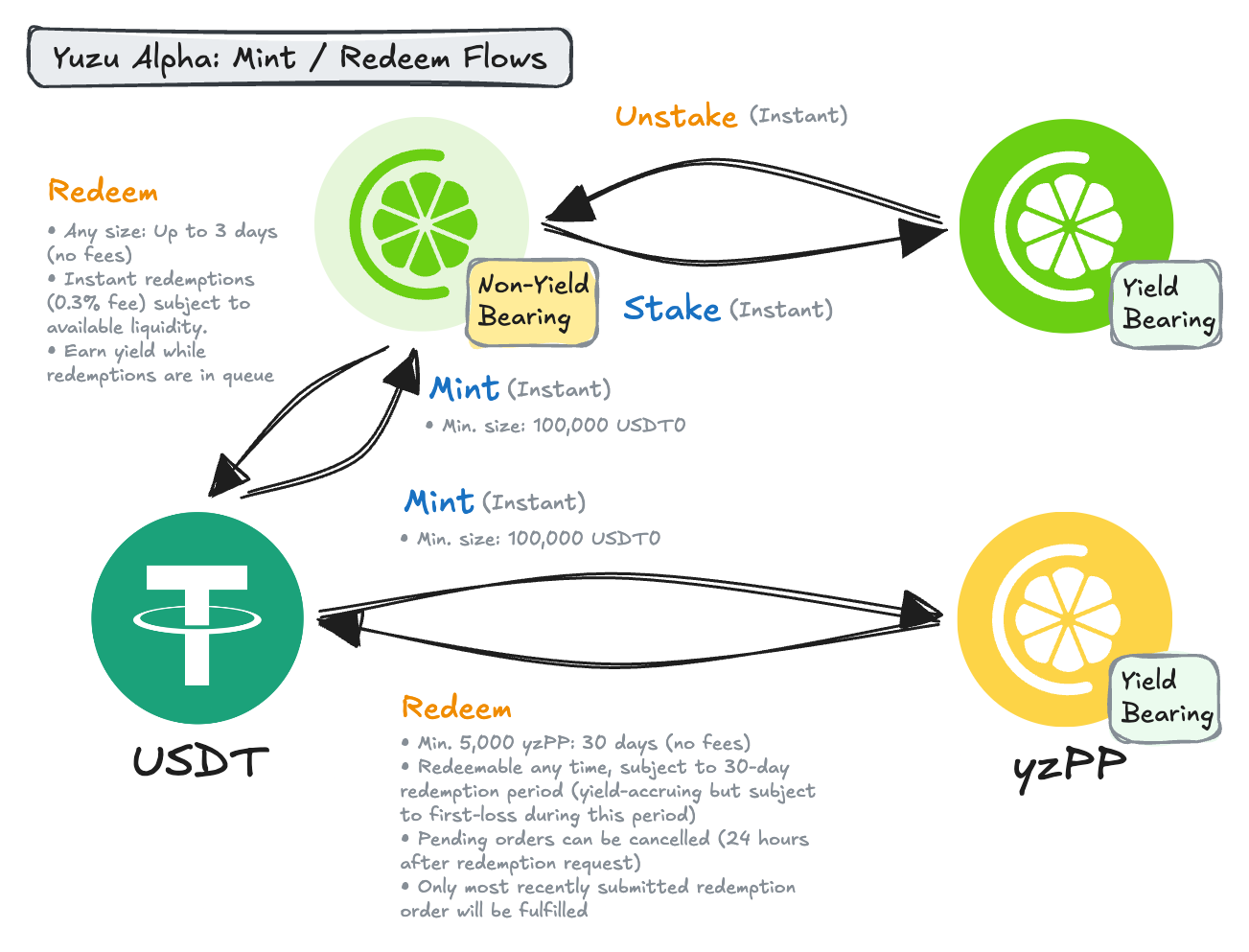
Product Fund Flows
The flow of funds for Yuzu Alpha is as illustrated below.
When the user mints or redeems yzUSD or yzPP, USDT0 is deposited into the Collateral Pool. USDT0 in the Collateral Pool is then deployed into curated DeFi strategies.
Reserve Fund
The Reserve Fund functions as both Yuzu Alpha's balance sheet buffer and "treasury".
At the start of every epoch, the protocol announces its yield distribution. Yield is then distributed from the Reserve Fund. During surplus weeks, when the protocol generates more yield than it distributes (realized P&L > distributed yield), the excess accrues to the Reserve Fund. During deficit weeks (realized P&L < distributed yield), the Reserve Fund underwrites the deficit.
Over time, consistent surplus capture is intended to grow the Reserve, stabilizing yields across cycles, strengthening long-term sustainability and accruing value to the protocol.
The Reserve Fund's primary uses includes:
- Value accrual to the governance token,
- Covering operating and administrative costs,
- Supporting ecosystem growth and strategic partnerships,
- Absorbing unforeseen losses that exceed yzPP's first-loss protection.
Liquidity Buffer
Onchain liquidity all Yuzu Alpha related assets.
Active liquidity is maintained across the following pools, with contract addresses listed as follows:
Liquidity Pool Contracts
| Blockchain | yzUSD | syzUSD | yzPP |
|---|---|---|---|
PlasmachainID 9745 | |||
MonadchainID 143 | - | - | |
EthereumchainID 1 | - | - | - |
HyperEVMchainID 999 | - | - | - |
SeiEVMchainID 1329 | - | - | |
PharoschainID 1672 | - | - | - |
Key Addresses
Core Yuzu Alpha Contracts
| Blockchain | yzUSD | syzUSD | yzPP |
|---|---|---|---|
PlasmachainID 9745 | |||
MonadchainID 143 | - | - | |
EthereumchainID 1 | - | - | |
HyperEVMchainID 999 | - | - | |
SeiEVMchainID 1329 | - | - | |
PharoschainID 1672 | - | - | |
BerachainchainID 80094 | - | - |
Vaults
- (Monad) YieldApp by Accountable
Wallets for NAV
- Main Wallet 1
- Main Wallet 2
- Main Wallet 3
- Main Wallet 4
- Main Wallet 5
- Main Wallet 6
- Main Wallet 7
- Main Wallet 8
- Main Wallet 9
- Solana Wallet 1
- Reserve Fund
- Liquidity Buffer
- yzUSD Mint Wallet
- yzPP Mint Wallet
Refer to our Independent Proof of Solvency by Accountable for the latest info.
Underlying Strategies
Principles & Mandate
Yuzu Money's (Alpha & Prime) strategies are:
- 100% onchain and verifiable via Accountable dashboard
- Bound by the Asset Whitelist
- Prioritizing capital preservation over yield
- [Yuzu Alpha] Tranched based protection (Overcollateralized yzUSD senior tranche supported by yzPP junior tranche and Reserve Fund)
Strategy Buckets
At a high level, Yuzu Alpha and Prime's backing strategies are as per the following:
| Strategy Buckets | Yuzu Alpha | Yuzu Prime |
|---|---|---|
| Tokenized U.S. Treasury Bills | Yes | Yes |
| A-grade Investment Credit (AAA Collateralized Loan Obligations - CLOs) | Yes | Yes |
| Overcollateralized Lending | Yes | Yes |
| Funding Rate Arbitrage | Yes | No |
| Leveraged Positions | Yes | Yes |
| (Cross-chain) Stablecoin Arbitrage | Yes | No |
1. Tokenized U.S. Treasury Bills
The U.S. Sovereign Rate, fully on-chain with near-instant liquidity. Issued by leading asset managers via Superstate, Securitize, Centrifuge, and others (BUIDL, VBILL, WTGXX, JTRSY).
2. A-grade Investment Credit (AAA CLOs)
Senior tranches of collateralized loan obligations. Zero principal loss in their 30+ year history. Tokenized via Superstate, Securitize, Centrifuge, and similar institutional vehicles (e.g., JAAA, STAC).
3. Overcollateralised Lending
Loans managed by Maple Finance / Syrup, strictly secured by high-quality liquid digital assets (BTC, ETH, XRP, etc.). Recourse and KYC'd institutional borrowers only.
4. Funding Rate Arbitrage
Indirectly positioned through platforms such as Ethena, or directly via fully on-chain trading platforms like Hyperliquid. Captures the persistent funding-rate spread.
5. Leveraged Positions
Spread capture on fundamentally backed assets (e.g., USDe/stables) within safe LTV thresholds. Uses fundamental / hardcoded oracles for price marking — eliminating market-driven liquidation risk.
6. (Cross-chain) Stablecoin Arbitrage
Spread capture across a basket of fundamentally backed stablecoins (USDT0, USDC, AUSD, USDG, USD1, USDS, DAI, PYUSD, cUSD, RLUSD, etc.). Sell premiums, buy discounts.
Accountable
Real-Time Proof of Reserves & Solvency, powered by Secure Enclaves and Zero-Knowledge Cryptography.
Accountable is a real-time financial verification platform powered by its Data Verification Network (DVN), using secure enclaves and zero-knowledge cryptographic proofs to verify reserves and solvency across both on-chain and off-chain systems — without exposing private positions or trading strategies. Backed by Pantera Capital and OKX Ventures, Accountable has verified over $1 billion in assets across clients including Galaxy and Amber Group.
Yuzu Money uses Accountable as an independent third party to attest to and report on protocol assets and key metrics in near real-time. Data is processed inside secure enclaves and verified via zkTLS and zero-knowledge proofs before being published, ensuring the dashboard reflects the protocol's true state and is tamper-proof.
The Yuzu dashboard displays key protocol metrics including total backing assets, collateralization ratio (Yuzu Alpha), products' yield performance (APY), and Fordefi workspace policies; all updated continuously and publicly verifiable.
Asset Whitelist
Strict adherence to investment framework for deployed strategies.
Overview
Yuzu Money maintains a curated Asset Whitelist defining where backing assets for Yuzu Alpha and Yuzu Prime may be deployed in respectively. Only whitelisted assets and protocols are eligible for allocation. When a new asset / platform is approved, a 7-day activation period applies before any funds are deployed. This gives users visibility into the boundaries of Yuzu Money's mandate before capital moves.
Live positions and exposures are verifiable at the Transparency dashboard under the Strategy Breakdown section.
What Gets Whitelisted?
For an asset or venue to be whitelisted, it must pass Yuzu Money's internal risk framework, which includes but is not limited to:
- Oracle and price-feed design
- Smart contract risk
- Economic / liquidity risk
- Counterparty and governance risk
- Alignment with our capital-preservation principle & mandate
Status Labels & Activation Rules
For each asset / platform combination, we display a status:
- Active
Within Yuzu Money's mandate to deploy backing assets into this asset / platform combination. Positions may already be live. - Activating
Approved by the risk committee, pending the 7-day activation window. No funds are deployed until the countdown elapses. - Paused
Disabled for new allocations. Existing positions are being monitored and unwound where appropriate.
Governance, Reviews & Pauses
- New assets and venues require a full risk review and collective sign-off before being added to the whitelist.
- Material changes, such as a protocol upgrades, oracle changes, or governance incidents may trigger a re-review and result in a downgrade to Paused or removal entirely.
- All whitelist changes are timestamped and publicly visible.
Oracles
As accurate asset pricing is fundamental to all onchain DeFi strategies, Yuzu Money utilizes RedStone Oracles as its primary data provider to ensure high-fidelity, real-time market feeds.
Yuzu Assets Oracles
| Blockchain | yzUSD | syzUSD | yzPP |
|---|---|---|---|
PlasmachainID 9745 | |||
MonadchainID 143 | |||
EthereumchainID 1 | - | - | |
HyperEVMchainID 999 | - | - | |
SeiEVMchainID 1329 | - | - | |
PharoschainID 1672 | - | - | |
BerachainchainID 80094 | - | - |
Oracle Data Sources (Underlying Strategies)
Yuzu Money leverages multiple oracle data sources and all strategies undergo a rigorous review prior to onchain deployment. The following are, but not exclusive to, the oracles data sources which we use (e.g. leveraged strategies in isolated vaults on money markets):
Hypernative / Sentinel
Leading real-time threat detection and prevention platform, with automated onchain actions for Web3.
Hypernative is a real-time threat monitoring layer across all onchain Web3 activities, with coverage across 70+ blockchains. Hypernative is one of the most battle-tested security platforms in Web3, trusted by the Ethereum Foundation, Chainlink, Uniswap, and Circle, among 250+ customers.
Yuzu Money integrates Hypernative as a core layer of its security infrastructure — one of the most widely deployed real-time threat monitoring platforms in Web3. To date, the platform has helped prevent over $2 billion in onchain losses across more than 250 institutional clients.
On top of Hypernative, Yuzu Money has also built Sentinel - a proprietary response system that connects threat detection directly to our Fordefi MPC wallet. When a threat is confirmed, Sentinel executes pre-authorized withdrawal transactions automatically, moving funds to safety in seconds without any manual intervention.
Key Features
Real-Time Detection: Hypernative monitors for threats before they land onchain — catching attack patterns forming in the mempool before block inclusion. Coverage spans smart contract exploits, oracle manipulation, phishing, governance attacks, and private key compromise signals.
Accuracy That Matters: Hypernative system offers a 99.5% exploit detection rate, a false positive rate below 0.001%, with 98% of hacks being flagged over 2 minutes before an exploit began.
AI/ML-Powered Engine: Hypernative detection combines machine learning models, behavioral heuristics, graph anomaly analysis, and live transaction simulation (via the Hypernative Guardian tool). This means other than known exploit signatures, novel and zero-day attack patterns are also surfaced.
Surgical Threat Blocking: Hypernative's Firewall can block a specific malicious wallet or contract from interacting with the protocol in real time, without pausing other DeFi activities; a key distinction and important factor for a yield engine protocol like Yuzu Money with various product suites.
Fordefi MPC
Wallet Infrastructure: Multi-Party Computation (MPC) Technology

Fordefi is a SOC 2 Type II certified (Ernst & Young) wallet infrastructure provider, and has undergone penetration testing security assessments by both Skylight Cyber and NCC Group. Fordefi is also insured through Munich Re, a global leader in reinsurance.
Yuzu Money uses Fordefi as our MPC wallet provider to safeguard and manage all protocol funds with institutional-grade security, access control, and seamless DeFi integration. Fordefi enables us to execute strategies efficiently, automate key operations, and maintain a complete, verifiable audit trail.
Key Features
MPC Technology: Fordefi's MPC technology eliminates single points of failure by distributing private key shares across multiple parties, combined with isolated hardware and biometric controls. This architecture ensures secure, non-custodial control over assets, significantly reducing the risk of key compromise.
Customizable DeFi Access Controls: We can whitelist specific DeFi protocols, smart contracts, and destination addresses. Transaction policies, approvals, and permissions are fully customizable per user, wallet, or strategy — allowing for granular, role-based access.
Institutional-Grade Workflows: Fordefi supports audit trails, transaction simulation, and policy enforcement — enabling us to maintain oversight, compliance, and operational rigor while interacting with complex DeFi strategies. The platform guarantees 99.9% uptime.
Automated Execution: Through Fordefi's robust API, we can programmatically trigger redemptions, rebalance portfolios, and respond to market events or security incidents in real-time, minimizing operational friction.
Chainlink CCIP (Transporter Bridge)
Yuzu Alpha (syzUSD) & Yuzu Prime (yzPrime)

Chainlink is the cross-chain interoperability standard built on Chainlink's Decentralized Oracle Networks (DONs) — the same oracle infrastructure Chainlink reports has enabled over $16 trillion in total value (TVE) across DeFi and traditional finance. CCIP secures cross-chain messaging and token transfers for leading protocols and institutional pilots, and underpins Transporter, its flagship bridging application.
Yuzu Money uses Chainlink CCIP to carry Yuzu Alpha (syzUSD) and Yuzu Prime (yzPrime) using the Cross-Chain Token (CCT) standard. Under CCT, Yuzu deploys and owns its own token pools — retaining full control of the bridge contracts, transfer mechanics, and per-lane rate limits. Cross-chain transfers are executed through Transporter, the CCIP-native bridge front-end.
Chainlink Token Manager
| Token | Standard | Chainlink Token Manager |
|---|---|---|
| Staked yzUSD (syzUSD) | CCIP Cross-Chain Token | Plasma <> Monad / Ethereum / HyperEVM / Sei / Pharos |
| Yuzu Prime (yzPrime) | CCIP Cross-Chain Token | Monad <> Ethereum |
The Token Manager dashboards are the authoritative source for each token's live pool addresses, supported lanes, transfer mechanism, and configured rate limits.
Why CCIP
Issuer-owned infrastructure: Yuzu retains complete ownership of its token contracts, token pools, and implementation logic. There is no vendor lock-in and no hard-coded external dependency — the bridge configuration is Yuzu's to manage across every chain.
Configurable rate limits: Each token pool enforces a rate limit with a maximum capacity and a refill rate, set per lane. This caps the value that can move across any single pathway in a given window — a hard, issuer-controlled ceiling on the blast radius of any anomaly, independent of the transport layer.
No liquidity pools, zero slippage: CCT uses audited burn/mint (or lock/mint) token pools rather than pooled liquidity. The exact amount sent on the source chain is the exact amount received on the destination chain, with no slippage and no fragmented liquidity to defend.
Security Model
CCIP is secured by Chainlink's Decentralized Oracle Networks and follows a defense-in-depth design, where independent layers each have to hold for a transfer to complete.
Committing DON: Observes and validates source-chain events and builds a consensus report of pending messages. No single node can commit a message; the report requires agreement across the oracle network.
Executing DON: Independently validates committed messages and executes them on the destination chain, releasing or minting tokens only against a verified commit report.
On-chain Risk Management safeguard: CCIP retains an on-chain Risk Management contract that acts as an emergency circuit-breaker over per-chain and network-wide functions, able to halt activity when required.
Rate limits and monitoring: Issuer-configured token-pool rate limits and continuous monitoring bound the exposure of any single lane and surface anomalies for response.
Audits
Security is our priority, we only work with the best auditors.

Pashov is a highly respected audit firm in the DeFi space, with a proven track record of securing protocols holding over $100B+ in total value locked (TVL). Their expertise is trusted by leading projects including Aave, Uniswap, 1inch, Lido, Ethena, and other industry leaders.

Dedaub is a reputable security firm renowned for its work with leading protocols such as the Coinbase, Ethereum Foundation, Chainlink, LayerZero, and EigenLayer, among others, with over $30B assets managed by audited code.
- [8th August 2025]: YuzuUSD Security Review (Pashov)
- [6th October 2025]: YuzuUSD Smart Contract Security Assessment (Dedaub)
- [14th January 2026]: YuzuUSD Security Review (Pashov)
- [9th February 2026]: YuzuUSD PSM Smart Contract Security Assessment (Dedaub)
- [7th July 2026]: Yuzu Money - July Security Review (Pashov)
- [30th July 2026]: YuzuUSD V3 Smart Contract Security Assessment (Dedaub)
Yield Generation
What are the yield mechanics and generation process for Yuzu Alpha and Yuzu Prime products?
Yuzu Money's yield strategies are fully onchain and independently verified in real time via the Transparency dashboard, powered by Accountable. For a full breakdown of active deployments, see Underlying Strategies.
Yield Generation Process
Opportunity Discovery: Programmatic scanning across protocols via APIs and crawlers, filtering for high-yield opportunities that meet Yuzu Money's risk parameters.
Risk Analysis: Each opportunity is assessed against Yuzu Money's internal risk framework, covering oracle design, smart contract exposure, liquidity depth, and economic sustainability before any capital is committed.
Execution: Allocations are executed semi-autonomously, with controls for timing, slippage, and best-execution efficiency via Fordefi MPC.
Monitoring & Protection: Active positions are monitored continuously via Hypernative for exploit detection and anomalous activity. Specific for Yuzu Alpha: in the event of a loss, the Yuzu Protection Pool (yzPP) acts as a first-loss buffer for yzUSD depositors.
Fundamental Oracles
What are fundamental oracles (used in money market DeFi platforms)?
A fundamental oracle prices an asset based on its intrinsic value (its NAV redemption value, what it can actually be redeemed for) rather than its market price on a DEX. For example, syrupUSDT can always be redeemed for USDT at NAV, even if a thin DEX shows it temporarily trading at $0.98.
Why this matters
Most DeFi liquidations are triggered by short-term market price moves on lending platforms. Fundamental oracles eliminate that risk because the oracle reports the asset's redemption value, not the volatile market quote. A leveraged position priced with a fundamental oracle can only be liquidated if the underlying yield economics genuinely break down — not because of a brief market dislocation.
Yuzu uses fundamental oracles wherever possible for leveraged positions, removing market-driven liquidation risk from the strategy.
Leveraged Strategies (Looping)
What is leveraged strategies (looping)?
Looping is a structured way to amplify yield on stable, fundamentally backed assets. The mechanic is straightforward:
- Deposit a yield-bearing asset (e.g., syrupUSDT earning ~3.6%) as collateral on a lending platform
- Borrow against it in a correlated stable asset (e.g., USDT) at a lower rate (e.g., ~3.1%)
- Use the borrowed funds to buy more of the yield-bearing asset
- Re-deposit and repeat — building up a leveraged position
The result: you capture the spread between collateral yield and borrow cost, multiplied by leverage. At ~10x leverage on a ~0.5% spread, this generates roughly ~8% additional yield on top of the base rate.
Why it's safe in Yuzu's hands
Yuzu only loops on assets backed by institutional-grade collateral (BTC, ETH, T-bills, blue-chip lending) with fundamental oracles. The position is only "liquidatable" if the strategy carries negative spread for a prolonged period — which is monitored daily and unwound long before any forced liquidation could occur.
Performance Fee
Does Yuzu Money charge a performance fee on the generated yield?
Instead of charging a performance fee on every positive P&L event which creates unpredictable yield and amplifies payout volatility, Yuzu Money dynamically adjusted APY distribution to depositors based on the following mechanisms:
Yuzu Alpha: How It Works
Surplus weeks: When realized P&L exceeds the distributed yield, the excess accrues to the Reserve Fund.
Deficit weeks: When realized P&L falls short, the Reserve Fund covers the gap.
This yield-smoothing mechanism is designed to deliver more consistent weekly distributions while allowing the protocol to pursue high-quality strategies whose returns may be uneven week to week.
Yuzu Prime: How It Works
Continuous yield adjustment based on what the underlying strategies and assets are yielding.
Yuzu Marketplace: How It Works
Continuous yield adjustment based on what the underlying strategies and assets are yielding.
Loss Coverage (Yuzu Alpha)
How losses are covered and in what order?
1. Yuzu Protection Pool (yzPP) The first-loss tranche. yzPP absorbs losses before any impact reaches yzUSD depositors. See Yuzu Protection Pool for how it is funded and sized.
2. Reserve Fund The Reserve Fund may also absorb unforeseen losses that exceed yzPP's first-loss protection. See Reserve Fund for details.
All loss coverage is subject to Terms and Conditions and available balances.